
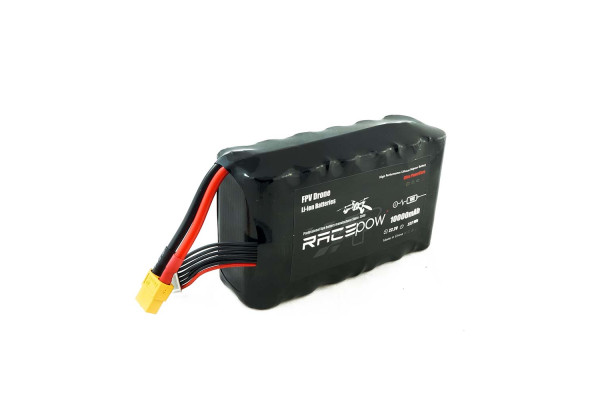
Racepow Liion 10000mAh 6S2P - Reliance RS50
Manufacturer claims: 10000 mAh · 6S · 830 g · Li-Ion
Buy at rotorama.com – €123.19Discharge curve
Flight test
Measured values
| Capacity | 9 941 mAh |
|---|---|
| Capacity honesty | 99.4 % |
| Flight score | 83 |
| Energy | 212.7 Wh |
| Peak C | 46.9 C (469 A) |
| Continuous C | 4.1 C (41 A) |
| Internal resistance (worst cell) | 4.07 mΩ |
| Internal resistance (cell average) | 3.88 mΩ |
| Specific resistance | 40.5 mΩ·Ah |
| Losses during the flight | 3.4 % |
| Punch voltage recovery | 5 mV |
| Weight | 830 g |
| Energy density | 256.3 Wh/kg |
| Energy per 1000 CZK | 70.9 Wh/1000 Kč |
| Dimensions | 43 × 77 × 130 mm |
How to read the values
Flight score — the result of a simulated flight on the discharge rig. Every battery of the class flies the same flight, consuming 84 % of its label capacity. The 0–100 score combines the weakest cell's sag at both punches, the minimum in the punch block, the mean voltage under load, the energy lost during the flight and the temperature rise. A battery the rig cut off during the flight did not finish and has no score (DNF).
Losses during the flight — energy turned into heat instead of thrust during the simulated flight, computed with the same balance as the heat losses: the area between the reference curve and the flight curve over the delivered charge. Lower is better.
Energy density — the reference-discharge energy per kilogram of battery mass including leads and connector. Higher is better – on small batteries every gram counts, on a whoop one gram is 5–8 % of the all-up weight. A higher energy density usually goes hand in hand with lower load capability, so read it together with the voltage under load (1S) or the continuous C (multi-cell packs).